
The Potato System

Stardew Valley Screenshot
One of my favorite games is Stardew Valley. Its a great game to relax to, but there are enough distinct things to do in the game that I always have a goal to achieve and a dream to aspire to. Of course, it isn't without its flaws, so one of my dream projects is to make a "farming" sim of my own someday. That project will require a lot of systems design. In fact, Stardew Valley had 3 major systems that I would like to call out: an Energy System (for digging, fighting, and eating), a building system (for upgrades, rocks, and projects), and an economic system (for bringing it all together). It had other systems, obviously, but these required the least amount of narrative work to make happen. Obviously, I would want to make my own game, rather than another Stardew Valley hack, so I created the Potato System. This is a system that uses a potato as its basis (as opposed to real life which uses water, the human body, a random rock, etc). This will be an example of how ridiculous making a system "realistic" truly is.
Some Assumptions were Made
Since everything is based off a potato, and not real life, we should approach this like how a cat would. Cats cannot understand that other creatures are not cats. Similarly, we cannot understand that other things are not potatoes. Most basic potato information can be gathered off of Google. When it can't we will make our own assumptions.
System: Energy Bar

Stardew Valley Energy Bar
The Energy Bar system would require 3 parts: digging, fighting, and eating. How does a potato factor into this? Well, potatoes have Calories, which burn, which is energy, so lets assume a person is like a furnace and just contantly needs fuel to power what they do (not much different from real life).
1 potato has 163 Calories (with a capital "C" - also known as kcals). Boxing for an hour burns about 800 Calories, so I'd need to eat ~ 5 potatoes to power my punches for an hour. (Getting stats for digging or swinging a sword were a little more difficult to find, so let's pretend that they take the same amount of energy). That's how much energy you're consuming... but how much are you exerting when you "punch" (aka fighting)? Well an expert puncher (or boxer) deals about 700 Joules per punch (which apparently feels like a gunshot). There are roughly 4,184 Joules in 1 Calorie, which means, assuming a perfect world where the same energy that goes in comes out, this person has 681,992 Joules to exert or 974 punches (wow). By comparison, Stardew Valley starts with 270 Energy. Since the character can do a lot, we convert by multiplying by boxing Joules (903,744,000 Joules) and then dividing by punching Joules. The result is 1,291,062.9 Punching Power in a day. I think 974 is a little more reasonable.
Finally, there's the eating. Do people in this made up world only eat potatoes? What if they need to make something? Is that made of potatoes too? For now, let's just say their values are adjusted based on how close they are to a potato...Let's try building first...
System: Building Materials
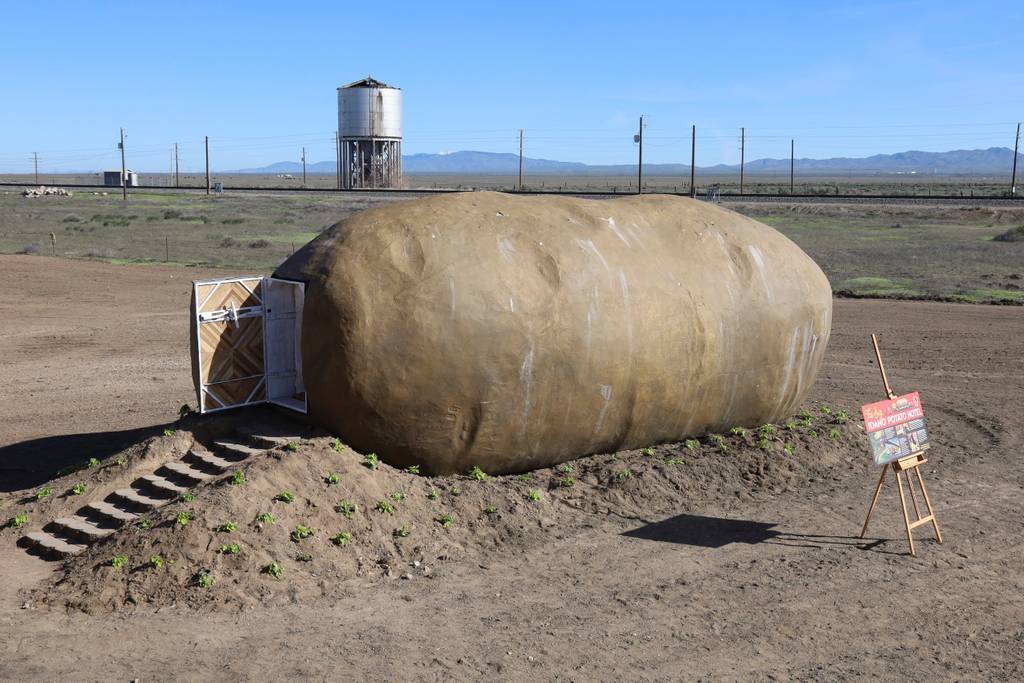
A Real Life Potato House (can be found in Idaho).
For a long time, I've been really interested in the economics and design behind home construction. As such, I'm really interested in what building a home would look like if everything was potatoes. Now, a whole house seems like a big project, so let's start smaller. Let's build a 1-car garage.
We're gonna build this thing out of brick and mortar (since its a little easier to think about). A standard brick weighs 5 pounds and is 8 in x 3 5/8 in x 2 1/4 in. A potato weighs 22 grams, has a 2.5 inch diameter, and is roughly hand sized (so 7 inches). 2 very different things. So, this can go 2 ways, by weight (and just condensed into brick size) or by volume (and we'll figure out the other differences from there).
By Weight
Condensing by weight means that 103 potatoes are going into the volumetric space of a brick. This means we have made a brick out of potatoes.
By Volume
Making a brick by volume just means that we essentially glue 2 potatoes together to make 1 brick (and it will weigh 44 grams). Its closer to using potatoes as stones more than it is making a potato brick.
The next most important part of trying to build a 1 car garage is how to glue it all together. Well, typically, you'd use mortar or concrete, or something similar. Unfortunately, none of those are potatoes. Instead, let's use mashed potatoes (since they look similar). 2 potatoes make 1 cup of mashed potatoes. One 80 lb bag of mortar makes about 4.5 gallons, so 72 cups of mashed potatoes should fill the same space.
A car garage is typically 12 ft x 20 ft x 7 ft. If I leave one wall open, this means I need, 1,808 bricks to make all 3 walls. Multiply that by how many potatoes go in a brick (103 or 2) and we've got a very large number. But we also need to glue them together! One bag of mortar covers 37 bricks, so we would need 49 bags. In total we would need somewhere between 10,672 and 193,280 potatoes to make a 1 car garage.
Why That Equation?
The equation used is called a Geometric Mean and is one of the 3 Pythagorean Means. You're probably most familiar with the Arithmetic Mean (add numbers together and divide by the total). This is great for numbers with the same meaning (like grades, or speed), but since our numbers aren't the same, this average would be a little too linear.
The Geometric Mean is often used when numbers vary by a lot and aren't necessarily independent of each other. The Harmonic Mean is the 3rd type, which is used to average different rates together. We don't have enough rates to warrant using this type of mean.
System: Potato Economics
Now, in order to actually make an economics system, I'd first need to do an awful lot of world building to truly understand the market value of any given good. That's too much work for the Potato System, so instead I'll do the bare minimum - everything is based off the assumption that potatoes make the best fuel.
To make a decent economics system, I like putting items together in an index (similar to real life, where a country's economic power is based off of their GDP). For the Potato System, we'll go with a simple index - how many potatoes did it take to "make" the item (a brick, by weight, takes 103), the time it takes to create the item (with a minimum of 1, because a potato takes 0 time to make), and how similar to a lump of coal (potato) the item is. "Like a lump of coal" is hard to measure. In short, if we've got 2 potatoes of varying size, but the same amount of energy is used up when burned, we'll want the smaller one. By that assumption, Calories (or energy) divided by the weight of an object should give a close approximation of that standard. Since we can't have zeros in this equation, a minimum of .001 is needed. Also to make sure a potato is the standard, we need to compare this ratio to a potato's ratio via division.
So, our equation looks like this:
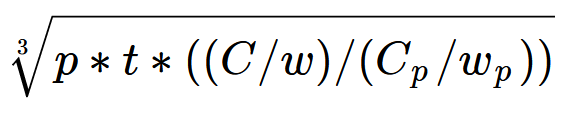
So we've got the equation, but how does it work? Well, a potato uses 1 potato, takes 0 minutes to prepare, and has 163 Calories to its 22 grams. In total, its economic value is 1. Its dirt cheap. Mashed potatoes, which require 2 potatoes, 20 minutes, and 214 Calories to its 242 grams, have a total economic value of 1.7. If we wanted to convert this to money, a pound of potatoes costs ~75 cents, so 1 potato is 3 cents. Multiply by 1.7 and we'll find that mashed potatoes in this system cost 51 cents.
The ultimate test is to check this system with something that normally isn't a potato, so we'll use the bricks we made earlier. Here is where world building really matters. Did we just glue 2 potatoes together? Or did we condense 103 potatoes together? Are the glued potatoes specialty potatoes (so together, they weigh 5 pounds)? How long does it take to condense 103 potatoes to be brick-sized? Clearly, its time to make things up!
Brick By Weight
Let's make up a time - 1 hour. It takes 1 hour to condense the brick. Now the economic value is (103*60*((.001/2,268)/(163/22))^(1/3) or 0.07, which means you're buying bricks by the pallet (because its value is too low otherwise).
Economic Value: 0.07.
Brick By Volume
If not doing this by weight, let's say it takes 1 minute to glue 2 actual potatoes together. The economic value would now be (2*1*((326/44)/(163/22)))^(1/3) or 1.26 and costs 4 cents a brick. Its also highly flammable. Without the flammability, it would be .02 or 0.0005 cents each. Finally, if each potato weighed 2.5 lbs and was still a potato, the economic value would be (2*1*((326/2,268)/(163/22)))^(1/3) or 0.34 (which would cost 1 cent each).
Economic Value (flammable): 1.26.
Economic Value (inflammable): 0.02
Economic Value (heavy and flammable): 0.34
BONUS: Each "potato" that's super heavy would be worth slightly less (an economic value of 0.27) than they are together, but still cost only 1 cent both individually and when glued together.
Conclusion
At the end of the day, there are many different ways to make a system out of a potato. The goal of this exercise was not to make it "like real life", but to provide a proper vehicle for absurdity. Why am I making a brick out of potatoes? Because it's fun. That's all it needs to be. And so long as it makes some modicum of sense (I did have to think about how a brick could be made out of potatoes), I can work it into a system that others can use to build their own weird potato economies (or adjust them to better match their own understanding of math, physics, and economics).