
A Personal Endeavor
I had picked up the Quest RPG system back when the pandemic had first started. I figured I could use it to write modules, since it was rules-light and fit themes and settings I was familiar with. My favorite part about it was that it was marketed as an "introductory" system; people could drop in and learn the ropes here a lot easier than they could in, say, classic D&D.
After learning the ropes myself and playing around in the space a little bit, I wanted to know what the market for module writing for this system looked like. I quickly joined Quest's community Discord and checked out what kinds of things had been posted on there. I found that newer Guides (Quest's version of a Game Master or referee) still had trouble understanding some core assumptions about role playing games. Since I've made tutorials for video games and a couple of how-tos for work, I figured this would be a good next step. Thus, the Tutorials Project was born.
What is the Tutorials Project?
The Tutorials Project is a personal project of mine to create encounter scenarios that teach both new players and a new Guide how to successfully run the scenario. I started with the typical combat encounter and am planning to make one for bartering and one for NPC social encounters. Even if the users don't necessarily understand the theory behind the encounter, they should at least have something they can run when they feel the need to (and it should reliably work).
The Combat Tutorial
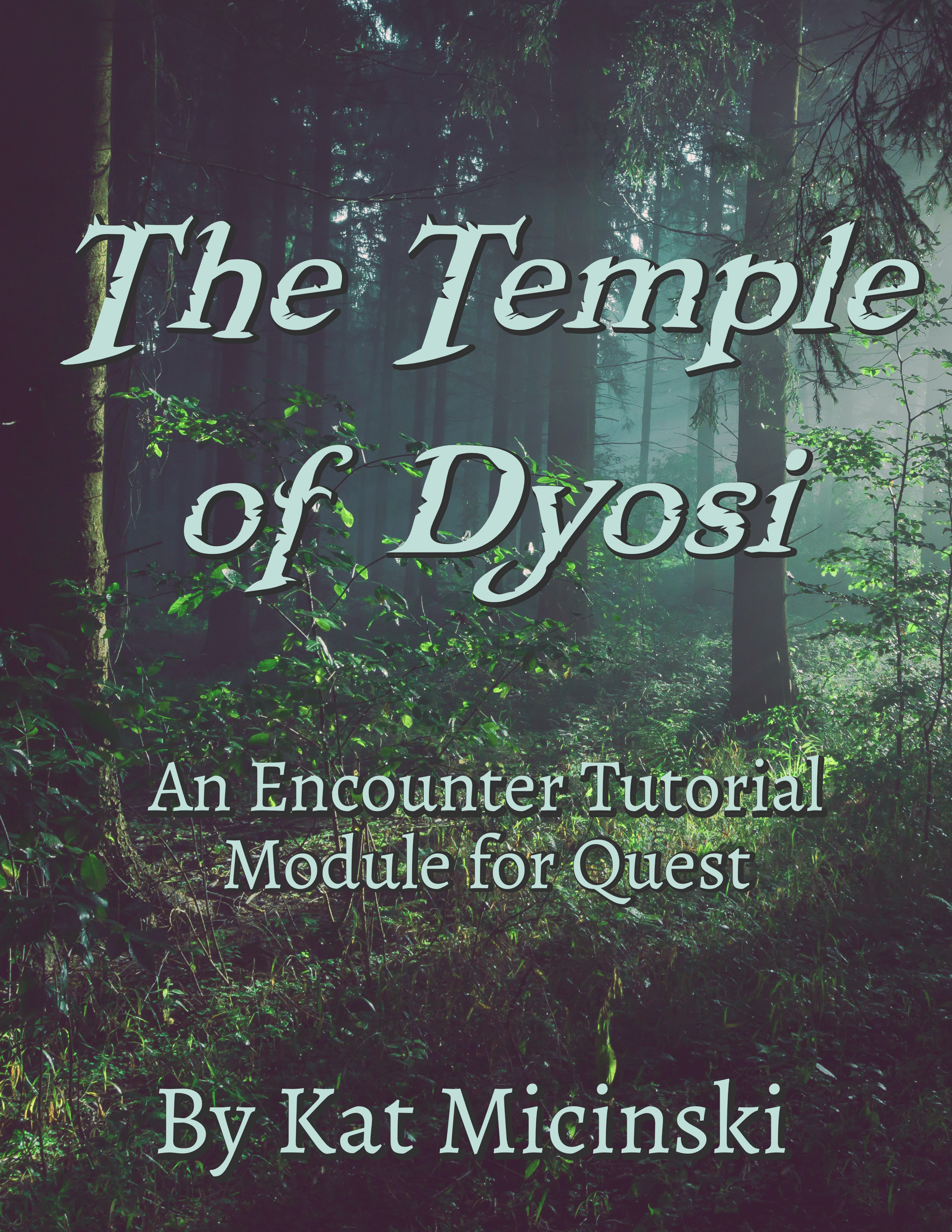
The Temple of Dyosi, now on itch.io!
I've already made the first tutorial for this project (and its Pay-What-You-Want). You can find it on itch.io here. In it, you fight golems, solve a puzzle, and retrieve the relic for safekeeping from those who wish to destroy it. While it does have a narrative, there are tips and guidelines for a Guide to be able to switch the narrative around to match the story they want to tell (like a pirate story instead of Indiana Jones).
More specifically, this module starts you off with basic principles about story flow. You open the scene by reading the exerpt provided by the module. This gives the players time to get into character and immerse themselves in the story. The hook happens (they get attacked and need to run into the temple) and they are promptly locked in with a single friendly NPC and all the time in the world. They can look around the room, take the opportunity to describe themselves, talk to the NPC, or anything else they may want to try. The NPC is there as a crutch of sorts to keep the players from trying to leave out the front door, getting stumped and not knowing what to do, and it gives the Guide a vehicle for providing hints without necessarily needing to break the immersion (an issue that can be tough for beginner Guides).
There's a puzzle to solve (encouraging the players to learn how to interact in game space) and enemies to fight. This combat encounter teaches how range bands work (which Quest utilizes heavily in their system) as well as how NPC abilities can change the game space (there's a guy who punches, a guy who shoots, and a guy who throws sticky bombs). When they finish the fight and solve the puzzle, they are rewarded by exiting the room and getting a special reward from an NPC. That NPC then also gives some story hooks (that the Guide is more than welcome to overwrite), to help teach that rewards don't have to be monetary (especially since Quest doesn't have a money system).
Future Plans
There are still two more modules in the works: a barter module and a "heist" module. Unlike the combat module these aren't as well "researched" or taught about outside of word of mouth or experience. My plan is to use concepts from LARPs and storytelling techniques to help a Guide know when and how to use the tools that will be utilized in these modules.
Barter Module
This module will teach how to barter with players in a way makes sense for the table. Shortly after Quest was first published, it needed to adjust to its customers and add in an item called Shinies. These functionally worked like "junk" because users weren't sure how to barter without them. My goal with this module is to show how to work with and without Shinies in ways that don't require a lot of prep work.
Heist Module
Working with NPCs, dropping hints, and solving mysteries can be a bit overwhelming for beginners. A lot of the concepts in this module will be a bit more advanced, but the goal is to teach how to roleplay without needing to be an expert in social experiences. This will likely cover things like morality, NPC incentives, and notoriety and how to keep those in check, both as a player and as a Guide.
Conclusion
Hopefully, these tutorials will make Quest even easier to get into. Guides can enter a game feeling confident in their skills and know-how. Players can feel like they're experts at playing the game and everyone can have a good time together. Keep an eye out for updates as I continue to work through these modules and publish them up on itch.io.